Managed Services
IT Outsourcing: Which Company Sizes Benefit Most?
When does IT outsourcing pay off for small, medium and large companies? Review the balance of cost, expertise and 24/7 support in managed IT services.
- Author
- İrem
- Category
- Managed Services
- Published on
- Updated on
4 min read
What Is IT Outsourcing, and What Does It Cover?
The idea that "IT outsourcing is for large companies" is still common. The reality is the opposite: the companies that benefit most from managed IT services are usually small and medium-sized businesses that cannot build their own IT team or cannot use the team they have efficiently.
In this article, we look at which company sizes IT outsourcing really makes sense for, when keeping IT in-house remains the better option and which questions to ask to make the right decision.
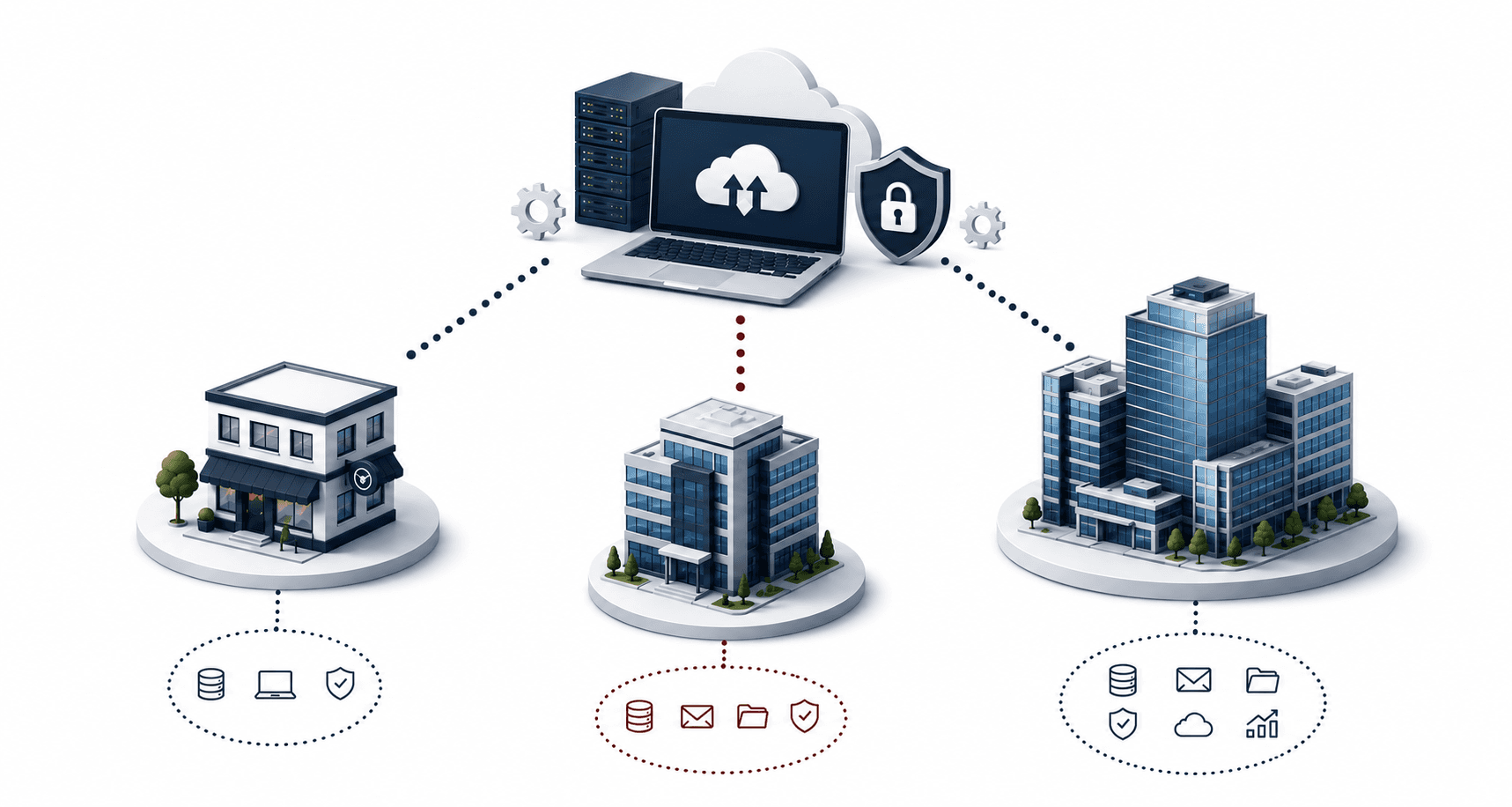
Managed IT services means that a business's IT infrastructure and processes are managed partly or fully by an external team of experts. The scope usually includes network management, server management, security monitoring, data backup, software license management and technical support .
An important point: outsourcing does not mean eliminating your existing IT team. In most cases, the internal team focuses on strategic planning and business development, while the external service provider takes on the daily operational load. The two are not competitors but complementary.
Which Company Sizes Benefit Most?
Small Businesses (1-50 Employees)
For companies of this size, building a full-time IT team usually does not make financial sense. The cost of employing a system administrator (salary, insurance, training, equipment) can be far higher than the cost of outsourcing. In addition, a one-person IT team leaves a support gap during leave or illness.
For small businesses, outsourcing provides access to enterprise-grade IT infrastructure without a large investment. With a fixed monthly fee model, the budget becomes predictable.
Medium-Sized Businesses (50-250 Employees)
This segment benefits most from outsourcing. These companies usually have a small internal IT team, but the team is so busy with daily operational issues (server maintenance, software updates, user support requests) that it has no time for strategic projects.
A hybrid model, where the internal team focuses on strategic topics and the external provider carries the operational load, offers the ideal balance for companies of this size. Especially in areas that require 24/7 expertise, such as cybersecurity monitoring (SOC) , outsourcing is much more economical than building an internal team.
Large Enterprises (250+ Employees)
In large companies, building a full IT department is usually both possible and necessary. Even here, however, outsourcing does not disappear completely. It is preferred especially in areas that require deep expertise and constant updating (SIEM/SOC management, disaster recovery, specialized security audits).
At large scale, the outsourcing decision is usually not about "sourcing everything externally" but about determining which areas are more efficient to keep in-house and which to outsource.
The Concrete Advantages of Outsourcing
Cost Predictability
IT management usually requires large and irregular budgets: hardware investments, license renewals and unexpected failure costs. In the managed services model, a fixed monthly fee removes this unpredictability.
Access to Expertise
It is hard for an internal IT team to have deep expertise in every area (network security, cloud architecture, data backup, system administration). External service providers give you access to a team with different areas of expertise.
24/7 Uninterrupted Support
Monitoring critical systems only during business hours means that outages after hours are noticed late. In the outsourcing model, 24/7 monitoring and response is offered as a standard service.
Focus on Your Core Business
Businesses can spend more time and resources on their core activities instead of IT management. This is a strategic advantage, especially for companies where IT is not the core line of business.
Is Outsourcing Always the Right Solution?
No. In some cases, keeping IT in-house can make more sense. If your company's IT infrastructure is highly specialized and industry-specific (for example, a custom software development process) and requires deep in-house knowledge, keeping that area internal may be the healthier choice.
In addition, in industries with very strict regulations that process highly sensitive data (for example, some financial institutions), certain processes may be kept fully in-house. Even then, a hybrid approach can still be valuable in areas such as monitoring and security.
Questions to Ask Before You Decide
When you make an outsourcing decision, it helps to ask yourself these questions:
- Does your current IT team spend its time on strategic work or on daily operational issues?
- When a critical system fails outside business hours, how quickly can someone respond?
- Is your IT budget predictable, or do you often face unexpected expenses?
- Is your company's growth rate straining your current IT capacity?
The answers to these questions will make clear how much sense outsourcing makes for your company.
Find the Right IT Model with Synchron Bilişim
The IT outsourcing decision depends more on the structure of your needs than on company size. At Synchron Bilişim, we offer flexible managed service models, compatible with your existing IT infrastructure, to companies of every size, from small businesses to large enterprises.
About the author
İrem