Cloud Technologies
Configuration Management and Automation in Cloud Security
Cloud environments change fast, so misconfigurations, where systems drift from their defined secure baseline, become a serious risk. Here is how to manage them with automation.
- Author
- Synchron
- Category
- Cloud Technologies
- Published on
- Updated on
7 min read
Cloud infrastructures change much faster than traditional data centers. New virtual machines can be deployed in minutes, network structures can be updated dynamically and services can scale automatically based on demand. This speed and flexibility bring important advantages, but they also bring a serious security risk: misconfiguration.
Misconfiguration occurs when a system drifts over time from its defined secure baseline settings. A port opened for testing and never closed, a storage bucket accidentally left public, or an IAM role with more permissions than necessary can turn into vulnerabilities that look small but have serious consequences.
For this reason, it is very important to review configuration policies regularly and use automated auditing tools.
The Most Common Misconfigurations
Most misconfigurations in cloud environments fall into similar categories. Recognizing these categories is the first step toward developing the right prevention strategies.
Over-Privileged Identity and Access Management (IAM)
This is one of the most common and riskiest types of error. Giving users, service accounts or roles more permissions than they need widens an attacker's room to move if an account is compromised. Moving away from the principle of least privilege creates a serious weakness in IAM configurations.
Storage Left Open to the Public
Misconfiguring storage in services such as AWS S3, Azure Blob Storage or Google Cloud Storage so that it becomes publicly accessible has been one of the most frequent causes of data breaches in recent years. Sensitive data exposed to the internet usually results from a simple configuration error.
Overly Broad Network Access Rules
Defining security group or firewall rules more broadly than necessary, for example allowing all IP ranges or all ports, significantly increases the attack surface. Leaving management ports such as SSH and RDP open to the internet is a particularly serious risk.
Disabled Encryption
Not enabling encryption by default for data at rest and in transit, or disabling it later, can lead to serious security and compliance problems. These settings are easy to overlook, especially in managed database services.
Lack of Logging and Monitoring
Not enabling audit logs, or not keeping them at a sufficient level, makes it harder to detect and investigate a security incident. A lack of logging and monitoring creates invisible risks in the environment.
The Fundamentals of Configuration Management
Configuration management is the set of processes, policies and tools that keep IT systems in a defined secure state. In cloud environments, this approach rests on three core elements.
Secure Baseline Configuration
It defines the minimum accepted security standards for each type of system. Which ports must be closed, which access policies are applied by default and which permissions are restricted are all part of this baseline. CIS Benchmarks, AWS Security Hub standards and the Azure Security Benchmark are common reference sources for this.
Detecting Configuration Drift
Once the secure baseline is defined, you need to track when and how systems drift from it over time. Manual checks quickly become insufficient. As the environment grows and the pace of change increases, automated auditing becomes essential.
Remediation and Rollback
Detecting drift is not enough on its own; the necessary fix must also be made quickly. In the ideal scenario, this process runs automatically, and the system is returned to its defined secure state or the related remediation process is triggered.
Configuration Security with Automation
The dynamic nature of cloud environments makes manual configuration management unsustainable. Automation not only increases efficiency; it also plays a critical role in delivering security consistently and at scale.
Infrastructure as Code (IaC)
Defining infrastructure in code is the foundation of the IaC approach. Terraform, AWS CloudFormation, Azure Bicep and Pulumi are the leading tools in this area. With IaC, infrastructure changes are placed under version control, reviewed and applied in a repeatable way.
From a security perspective, its most important advantage is that the approved configuration is defined as code and every deployment follows that definition. This makes manual changes easier to detect.
Policy as Code
This means defining security policies as machine-readable rules. Open Policy Agent (OPA), HashiCorp Sentinel and AWS Service Control Policies are leading examples of this approach. Policies can be enforced automatically before deployment or at runtime.
For example, rules such as "no storage bucket may be public" or "all virtual machines must have specific tags" can be defined as code and audited automatically by the system.
Continuous Compliance Auditing (CSPM)
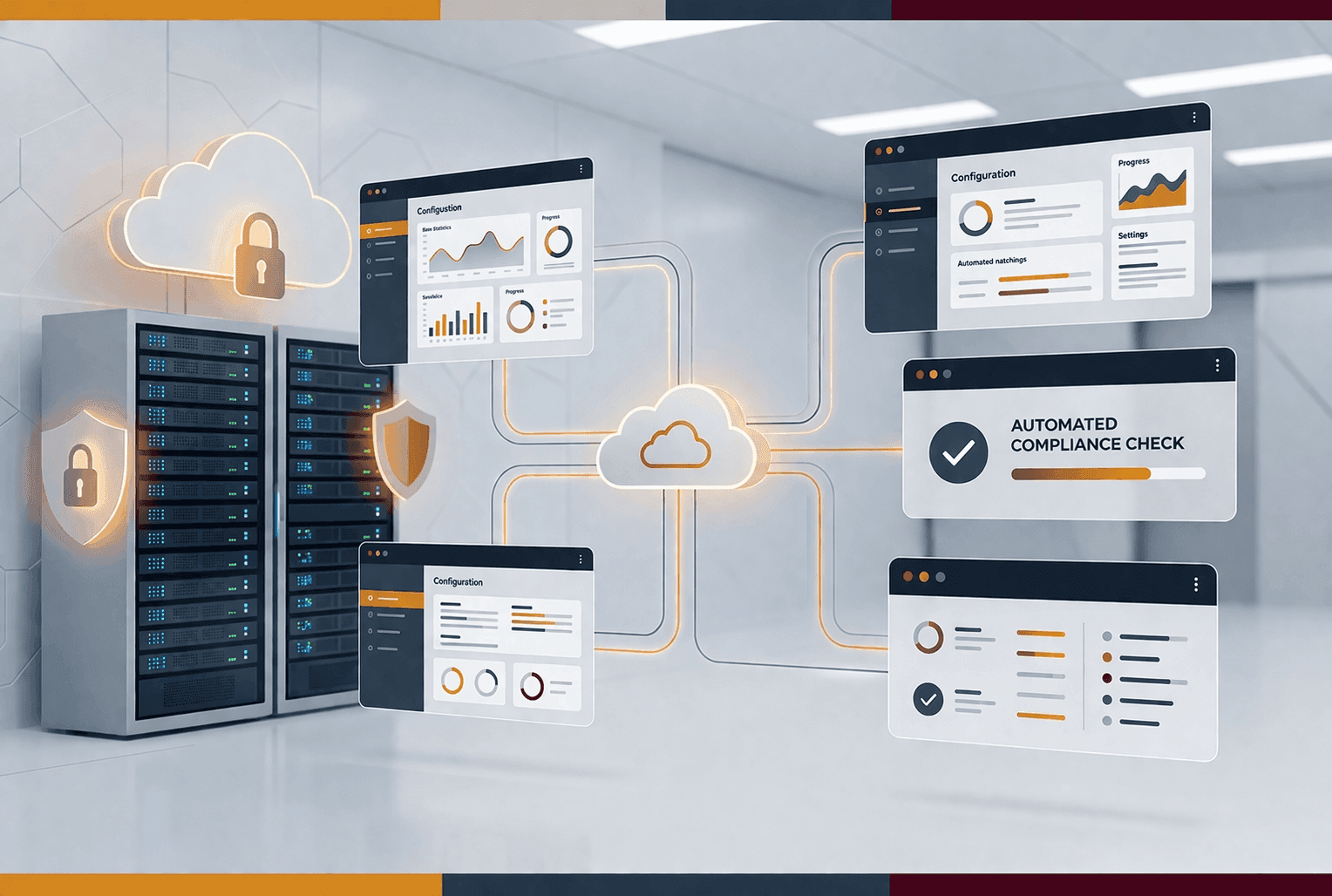
Cloud Security Posture Management tools continuously scan the cloud environment and compare its current state with the defined security policies. When they detect a deviation, they raise an alert, generate reports and in some cases can start an automatic remediation process.
Prisma Cloud, Wiz, AWS Security Hub, Microsoft Defender for Cloud and Lacework are among the common solutions in this area. These tools often combine capabilities such as IaC scanning, identity analysis and network visibility on a single platform.
Security Checks in CI/CD Pipelines
Integrating security checks into the development process lets you detect issues before they reach production. Tools that scan IaC files can be integrated easily into CI/CD pipelines.
With this approach, security checks do not depend on manual review; they run automatically with every code change.
Practical Implementation: Where to Start?
Moving to configuration management and automation does not have to be a large, complex transformation project. A gradual, prioritized approach is both more sustainable and delivers results faster.
Start with Inventory and Visibility
You cannot manage what you cannot see. The first step is to inventory all resources in the cloud environment and make the current configuration state visible. CSPM tools can give you a quick start at this stage.
Prioritize High-Risk Areas
Identity and access management, public storage and network access rules are usually the highest-risk areas. Starting your automation work with these topics delivers more effective results.
Make IaC the Standard for New Projects
Moving your entire existing infrastructure to IaC at once can be difficult. However, making this approach the standard for new projects leads to a more controlled transformation over time.
Define Remediation Processes in Advance
Define in advance how to act when a non-compliance is detected. Which findings are fixed automatically, which require approval and which are treated as acceptable risk: making these decisions in advance is very important.
The Configuration Security Tool Ecosystem
The tools used in this area generally fall into four main groups.
IaC Development Tools
Terraform is one of the most widely used tools for defining infrastructure as code in multi-cloud environments. AWS CloudFormation and Azure Bicep are infrastructure definition solutions specific to their cloud providers. Pulumi lets you manage infrastructure directly with programming languages.
IaC Security Scanning Tools
Checkov can scan many infrastructure definitions, such as Terraform, CloudFormation and Kubernetes, for security issues. tfsec is a lightweight, fast scanner focused specifically on Terraform code. Terrascan stands out with its policy-based auditing approach.
CSPM Tools
Wiz is a CSPM platform that analyzes the cloud environment through its relationships and provides high visibility. Prisma Cloud offers broader cloud security capabilities, with CSPM at the core. Microsoft Defender for Cloud is Azure-centric but also supports multi-cloud environments. AWS Security Hub collects and tracks security findings centrally for AWS services.
Policy Management Tools
Open Policy Agent (OPA) is a flexible policy engine that can be used in different environments. HashiCorp Sentinel is one of the preferred solutions for policy enforcement, especially in Terraform Cloud and Enterprise environments.
With Synchron Bilişim, Strengthen Your Cloud Security
Configuration security and automation are not a one-time effort; they are a process that needs continuous improvement. With the right strategy, the right tools and the right implementation approach, cloud environments can become much more secure, visible and manageable.
At Synchron Bilişim, we assess your existing cloud infrastructure, analyze configuration risks, define your security policies and integrate the IaC, policy management and CSPM solutions that fit your needs into your environment. Our goal is not only to reduce current risks but also to build a sustainable approach to cloud security.
To see the security level of your cloud environment and clarify your improvement roadmap, contact the Synchron Bilişim experts.
About the author
Synchron