Cloud Technologies
What Is the 3-2-1 Rule, and Why Is It Vital?
The 3-2-1 rule is one of the most fundamental and widely accepted backup approaches worldwide for minimizing the risk of data loss. Here is how it works and why it matters.
- Author
- Synchron
- Category
- Cloud Technologies
- Published on
- Updated on
6 min read
Today, digital data is among the most valuable assets for both individuals and organizations. However, many risks, such as hardware failures, user errors, cyberattacks, ransomware and natural disasters, can cause this data to disappear in an instant. This is why it is critical not only to store data but also to back it up correctly.
The 3-2-1 rule is one of the most fundamental and widely accepted backup approaches worldwide for minimizing the risk of data loss. It provides a simple, practical and effective framework that helps you protect your data without depending on a single point. It is vital for anyone who wants to ensure business continuity, minimize potential downtime and be prepared for the unexpected.
What Is the 3-2-1 Rule?
The 3-2-1 rule is one of the cornerstones of a data backup strategy. First defined by photographer and author Peter Krogh in 2009, the approach is now officially recommended by the FBI, CISA and leading cybersecurity organizations around the world.
The rule consists of three simple, easy-to-remember numbers:
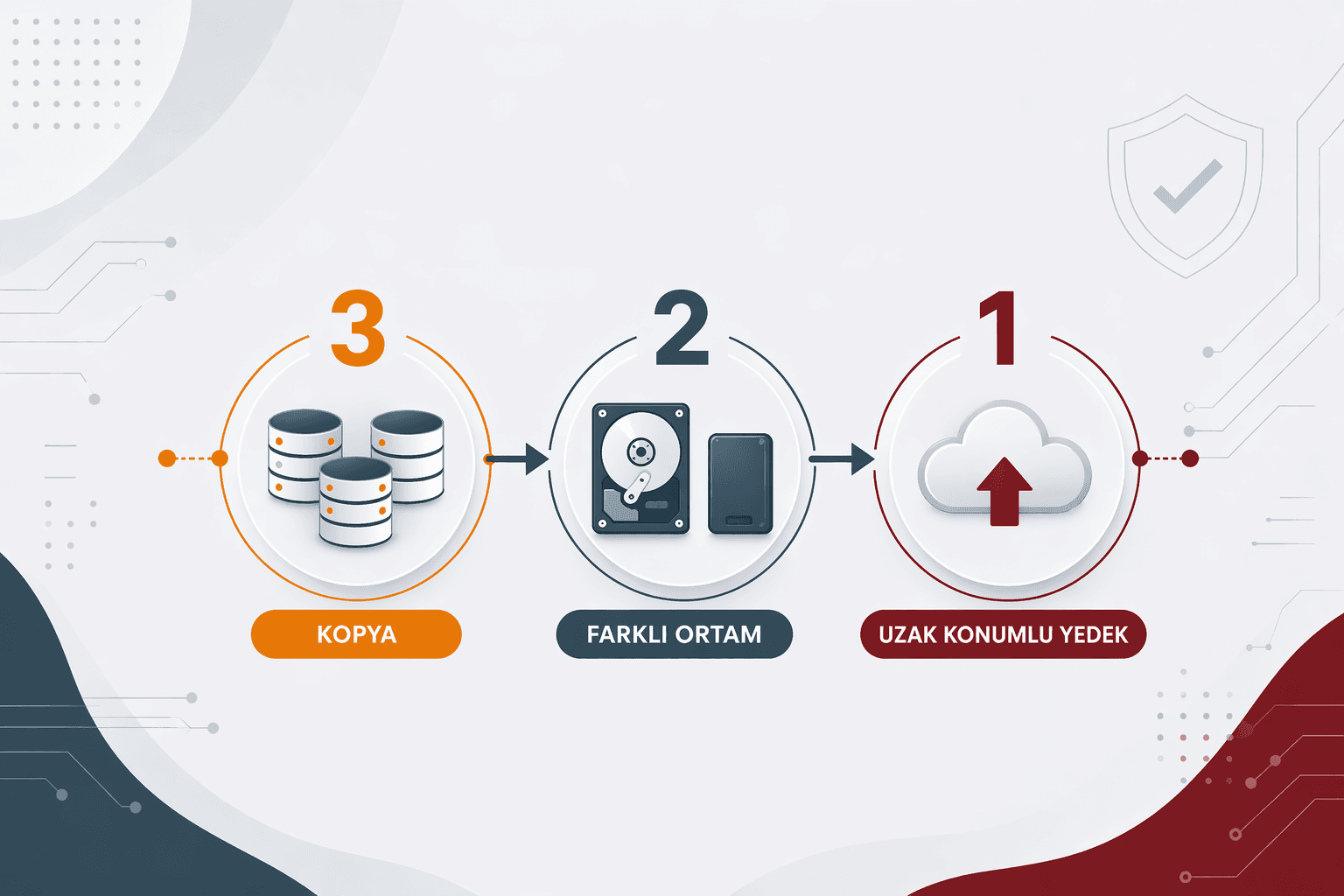
3 → Keep 3 copies of your data (1 original + 2 backups)
2 → Store the backups on at least 2 different types of media
1 → Keep at least 1 of the copies in a different physical location
The Meaning Behind the Numbers
"3": Three Copies
There is a common saying in IT: One backup is no backup. When the original file is corrupted, you may find that your only backup does not work either. The backup job may also have failed, and this often comes to light only when you need the backup.
This is why three copies provide stronger protection. Even if one is corrupted or inaccessible, the other copies take over.
"2": Two Different Types of Media
Storing all backups on the same type of media is risky. Disks of the same type can fail in similar ways, drives in the same NAS can be affected by the same problem, and relying only on the cloud can cause problems during internet or service outages.
For this reason, we recommend keeping backups on at least two different types of media, for example internal disk + external disk or NAS + cloud storage.
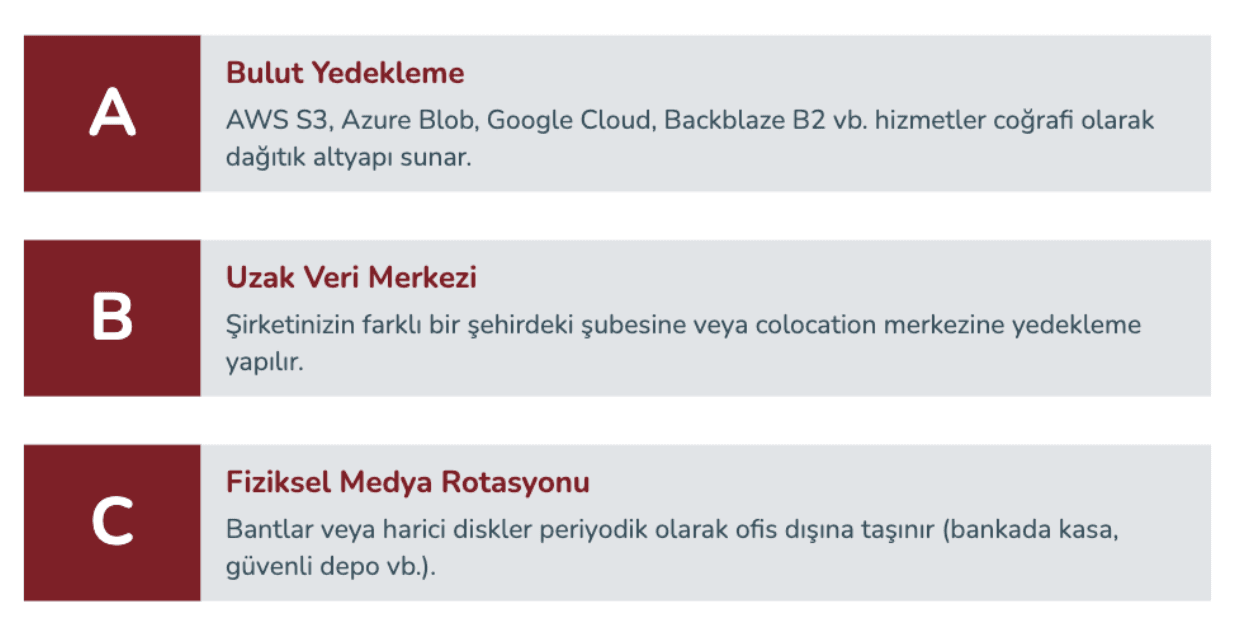
"1": One Copy in a Different Location
This is the most critical part of the rule. In the event of fire, flooding, an earthquake or theft, all copies kept in the same place can be lost at the same time.
To reduce this risk, at least one backup must be kept in a different location . This provides extra protection against physical disasters.
What Risks Do You Face Without the 3-2-1 Rule?
Organizations without an adequate backup strategy face these main risks:
Ransomware:
Today, ransomware targets not only live data but also network-connected backups. Without a backup kept in a different location or isolated from the network, data recovery becomes much harder.
Hardware failures:
Hard disks and SSDs can fail over time. If there is no backup when a disk suddenly fails, data can be lost permanently. Also, RAID systems are an availability solution, not a backup.
Human error:
Accidentally deleted files, overwritten documents or incorrect operations can cause serious data loss. Multiple backup copies reduce the impact of such errors.
Physical disasters:
Events such as fire, flooding, earthquakes or theft can affect all systems in the same place. For this reason, it is very important to keep at least one backup in a different location.
How Do You Apply the 3-2-1 Rule?
Step | What to do | Details |
|---|---|---|
1 | Identify your data | Decide which data is critical. Prioritize ERP, accounting, CRM, email and project files. |
2 | Choose your backup tools | Pick the one that fits your needs from Veeam, Acronis, Windows Server Backup or cloud-based solutions. |
3 | Plan media and locations | A local NAS + cloud combination is a good option for many SMEs. Always plan for location diversity. |
4 | Set up automation | Manual backup is prone to human error. Create automatic, scheduled backup policies. |
5 | Test regularly | The value of a backup is proven by a restore test. |
3-2-1 for SMEs: No Big Budget Required
Many small and medium-sized businesses postpone setting up a backup system because they think it is expensive. In reality, this is often not the case.
A basic NAS and cloud backup solution can be set up for a few hundred TL a month. By contrast, the cost of data loss can be much higher because of lost business, damaged customer trust and potential legal consequences. Cloud storage costs have also fallen significantly in recent years, and many backup software vendors now offer licensing options suited to SMEs.
With the right planning, every organization, whether it has 5 or 500 employees, can benefit from the basic protection the 3-2-1 rule provides.
The Modern Variant: The 3-2-1-1-0 Rule
As cyber threats have evolved, the 3-2-1 rule has expanded over time. Today, many security experts recommend the 3-2-1-1-0 rule for stronger data protection. This approach builds on the classic 3-2-1 model and adds extra layers of security, especially against ransomware and data integrity risks.
3 → Keep 3 copies of your data.
2 → Store the backups on 2 different types of media.
1 → Keep 1 of the backups in a different location.
1 → Keep 1 of the copies offline or isolated from the network.
0 → Aim for 0 errors in restore tests.
Verify with tests that your backups work, and leave no room for errors in the restore process.
Secure Backup with Synchron Bilişim
At Synchron Bilişim, we put the 3-2-1 and 3-2-1-1-0 principles at the center of all our backup projects to maximize our customers' data security. We design sustainable, secure backup infrastructures that match your business needs and protect your data not only for today but also against potential risks in the long term.
Our services in this area include enterprise needs analysis and backup architecture design, installation and management of hybrid (on-premises + cloud) backup solutions, creation of automated backup policies, configuration of monitoring infrastructure, regular restore tests and reporting, and 24/7 technical support.
Taking the right step before a risk materializes makes a big difference, compared with looking for a solution after data loss. Synchron Bilişim's experts are here to help you build a secure, scalable and practical backup strategy tailored to your business.
About the author
Synchron