Cyber Security
Before You Sign the Policy: 5 Technical Requirements for Cyber Insurance
Before you sign a cyber insurance policy, check the 5 technical requirements insurers look for: MFA, EDR/MDR, isolated backups, an incident response plan and central logging.
- Author
- İrem
- Category
- Cyber Security
- Published on
- Updated on
5 min read
You assume your insurance will cover the damage after a cyberattack. You have a policy, you have paid your premium, you are covered. Or so you think. But when you file your claim, the insurer's response may not be what you expect: "Your claim cannot be considered because the security controls specified in the policy terms were not in place."
The cyber insurance world has changed fundamentally in recent years. Insurers no longer issue a policy simply in return for a premium; they require your organization to have concrete, provable security controls. Companies that do not meet these requirements either face very high premiums, cannot get a policy at all or, worst of all, have their claim rejected after an incident. So what exactly are insurers asking for in 2026?
Why Does Cyber Insurance Now Require a Technical Assessment?
As the frequency and cost of ransomware attacks rose, insurers began to struggle under the claims they paid. As a result, the industry moved to a model that assesses risk more rigorously. Today, a cyber insurance application has effectively become a technical audit: the insurer measures the likelihood of your organization being attacked, and of suffering damage when it is, through concrete controls.
The most critical point is this: insurance does not replace technical readiness. A policy exists to soften the financial consequences of an attack, not to prevent the attack or exempt you from basic security measures. What is more, if you do not actually apply the controls you declared on the application form, this can be grounds for rejecting your claim after an incident. For this reason, before you sign a policy, it is critical to assess whether your infrastructure truly matches the insurer's expectations.
5 Essential Technical Requirements Insurers Ask For
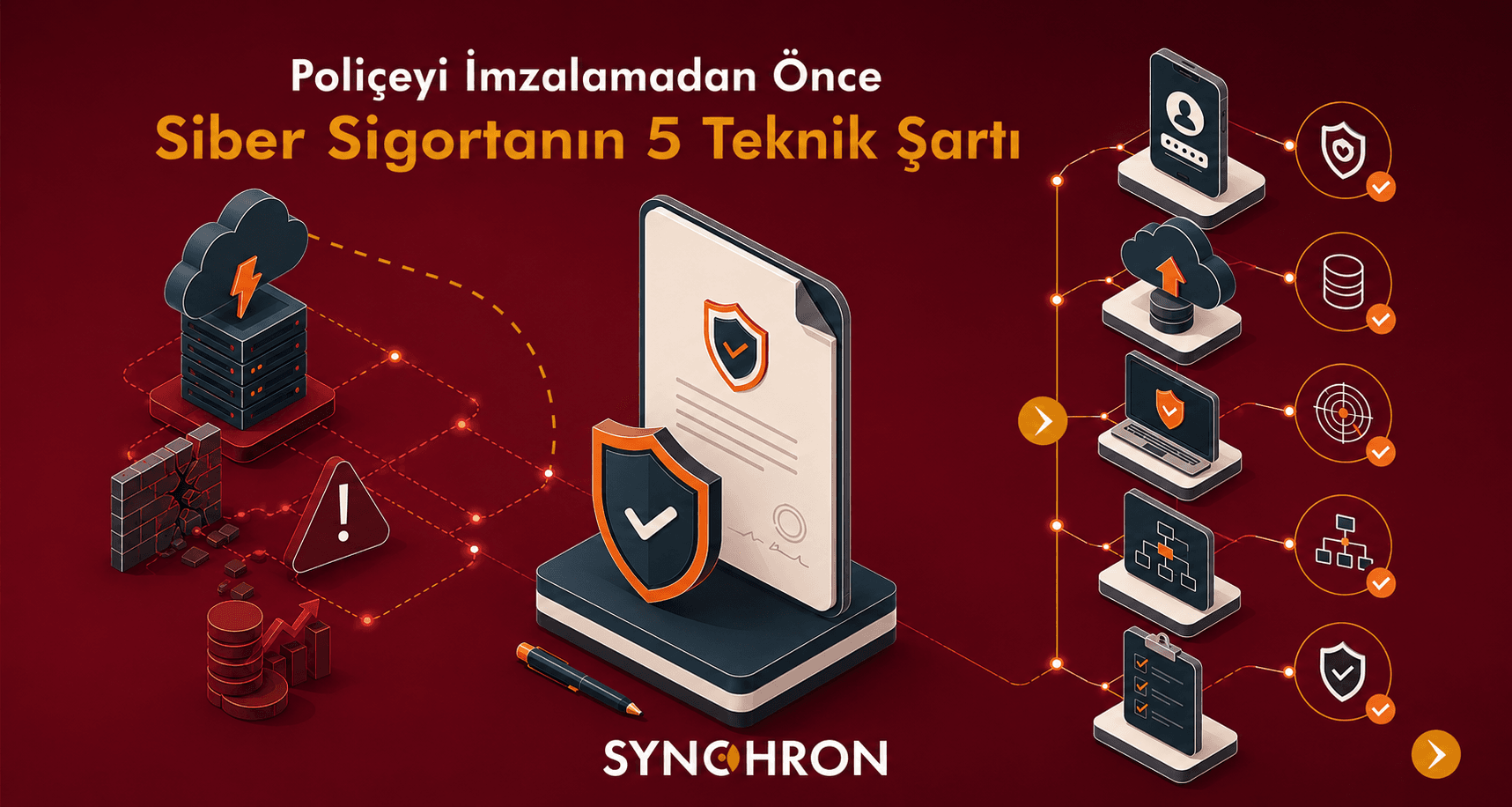
Details vary between insurers, but in 2026 five core controls stand out in almost every application. Here is what you should review before taking out a policy:
1. Multi-Factor Authentication (MFA)
MFA is the first requirement on which insurers do not negotiate. They expect MFA to be enabled on all user accounts, especially VPN, remote desktop access and administrator accounts. Missing or partial MFA is one of the most frequently cited reasons for rejecting cyber insurance claims.
2. Endpoint Detection and Response (EDR/MDR)
Classic antivirus is no longer considered enough. Insurers require EDR solutions that can detect and respond to threats in real time and, increasingly, managed detection and response (MDR) services that provide 24/7 monitoring. Systems monitored only during business hours now fall short for many policies.
3. Regular and Isolated Backups
Having backups is not enough; they must be tested regularly, kept isolated from the main system (offline or immutable) and monitored. Ransomware cases in which the backups were also encrypted have pushed insurers to be much more rigorous here. It is notable that the backup question is the section most often answered incorrectly or incompletely on application forms.
4. A Documented Incident Response Plan
A written incident response plan that defines who does what, and in what order, during an attack is now a standard expectation. Insurers want not only the plan to exist but also clearly defined responsibilities, regular testing (tabletop exercises are accepted) and an escalation chain.
5. Central Logging and Monitoring
Central log collection across endpoints, network and identity systems, with defined retention periods and active monitoring, is increasingly required for policy approval. This control also lets you prove after the fact what happened during an incident, which can be decisive in the claims process.
A rising expectation: Zero Trust
In addition to the five requirements above, components of the Zero Trust approach, such as the principle of least privilege, network segmentation and identity-based access controls, are increasingly required in policies. Steps in this direction can both lower your premium and strengthen your application.
Conclusion: A Policy Is Not a Shield but a Complement
When structured correctly, cyber insurance is a valuable safety net, but it never replaces your technical readiness. Before you sign a policy, make sure you meet these five core requirements, from MFA to backups and from EDR to an incident response plan. This lets you get insured at more favorable premiums and, most importantly, ensures your claim is actually paid after an incident.
At Synchron Bilişim, we assess your organization's existing security infrastructure against insurers' expectations and support you in correctly setting up MFA, EDR/MDR, backup, logging, incident response planning and other cybersecurity controls. To check together whether your infrastructure is ready before you sign your policy, contact us.
Frequently Asked Questions
Is MFA mandatory for cyber insurance?
In practice, yes. Many insurers do not issue a policy without MFA, especially on VPN, remote desktop and administrator accounts; partial implementation can be grounds for rejecting a claim.
Why do insurers require EDR instead of antivirus?
Classic antivirus catches known signatures; EDR monitors behavior on the endpoint and can respond to suspicious activity in real time. Insurers are also increasingly looking for MDR services that provide 24/7 monitoring.
I have backups. Is that enough?
Not on its own. Backups are expected to be tested regularly, kept isolated from the main system (offline or immutable) and monitored, because backups can also be encrypted in ransomware attacks.
What happens if I make a false declaration on the application form?
If you do not actually apply the controls you declared, your claim can be rejected after an incident. For this reason, verify your technical status before you fill out the form.
About the author
İrem