Artificial Intelligence
How Should Companies Protect Their Data When Using AI?
AI data security is critical for companies, especially for KVKK (Turkish data protection law) compliance. We cover the main risks and 7 concrete measures you can take.
- Author
- İrem
- Category
- Artificial Intelligence
- Published on
- Updated on
5 min read
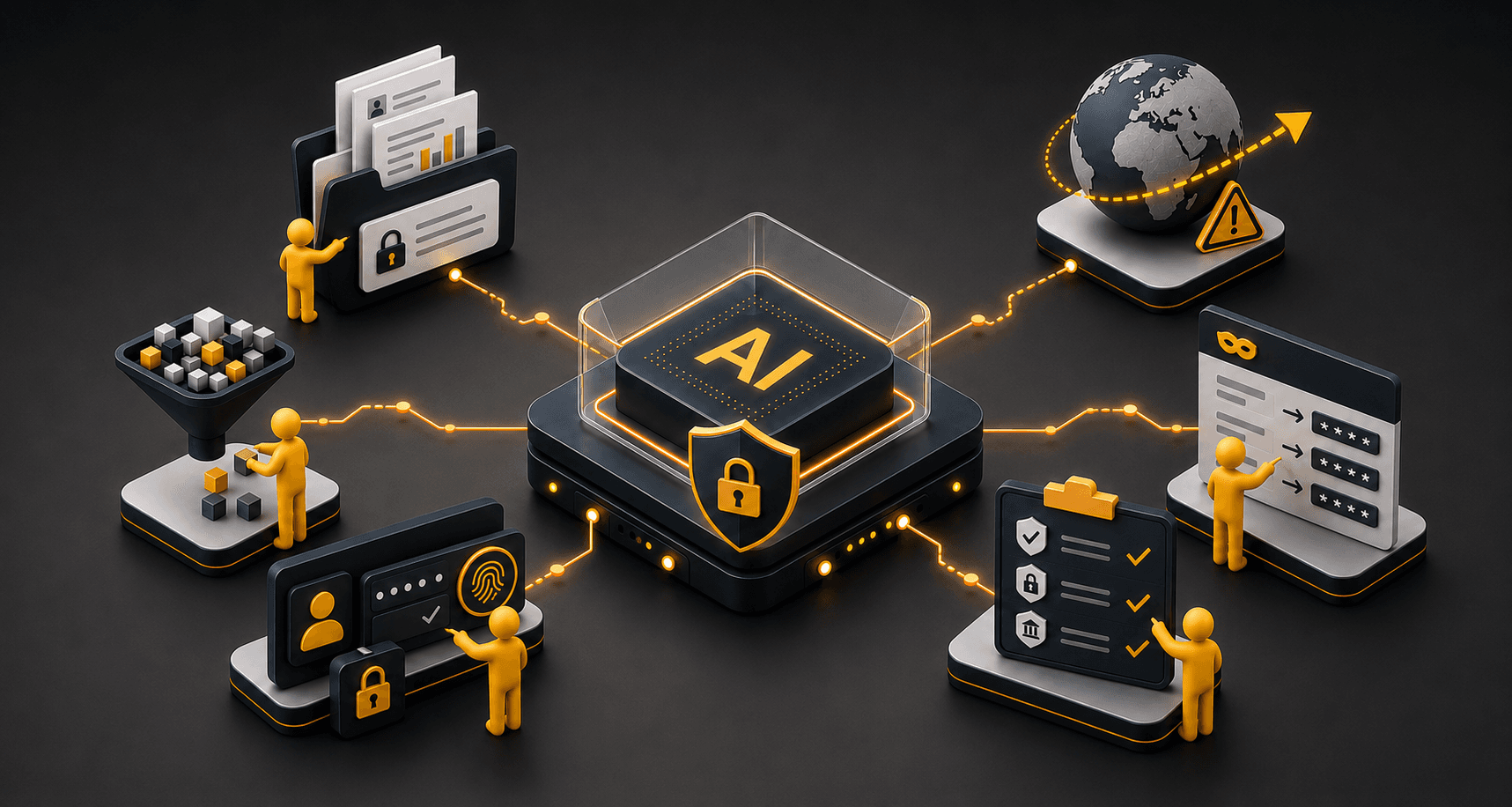
AI data security has become a priority that companies cannot ignore. An employee pastes a customer complaint report into ChatGPT to get a summary. A developer sends a block of code containing personal data to an AI tool for debugging. The HR team screens job applications with an AI tool. All three scenarios happen frequently in everyday business, and all three unknowingly create a serious risk under KVKK (Turkey's Personal Data Protection Law).
The rapid integration of AI tools into business offers a big opportunity for productivity, but it also brings new and often overlooked risks for data security. In this article, we look at the main risks companies face when using AI and concrete ways to manage them.
Where Does the Problem Come From?
Large language models (LLMs) are systems designed to work with continuously supplied input data. Text that an employee pastes into an AI tool can end up in that tool's data pool without anyone noticing. This means internal information, customer data and trade secrets can turn into an uncontrolled data leak.
And this is not just a theoretical risk. With its "Guide on Generative AI and the Protection of Personal Data", published on November 24, 2025, the KVKK authority put this issue on an official footing. Every company that uses AI must now take this guide into account.
Which Data Is at Risk in AI Data Security?
The types of data passed to AI tools within a company usually fall into these categories: customer information (name, phone, email, Turkish national ID number), financial data, health information, documents related to legal proceedings and trade secrets. Much of this is classified under KVKK as "personal data" or "special categories of personal data."
Voice recordings, image data and data processed for biometric recognition are especially important. If an AI tool processes a voice recording not only for transcription but also for identity verification or sentiment analysis, that data counts as biometric data and falls under KVKK Article 6.
The Main Risks Companies Face
Cross-border data transfer
The servers of most popular AI tools are located abroad. Transferring data to countries without an adequacy decision, or without appropriate legal safeguards (such as standard contracts), violates KVKK Article 9. This is one of the most common violations and one of those subject to the heaviest sanctions.
Lack of a legal basis
Each AI processing step (data input, processing and output generation) counts as a separate data processing activity. Each one requires one of the processing conditions listed in KVKK Articles 5 and 6. Many companies roll out AI tools without clarifying this legal basis.
Violation of the data minimization principle
Employees often share more data than necessary. Pasting an entire document as-is to get a report summarized means also passing the unnecessary personal data in it to the AI.
What Measures Should Companies Take?
1. Create an AI usage policy
You need a policy that clearly defines which AI tools employees may use, with which types of data and under which conditions. The policy should include a list of approved tools, prohibited data categories and the process to follow in the event of a violation.
2. Set up a data masking layer
Placing a PII (personally identifiable information) masking layer on data traffic from the company network to AI services is an effective technical measure. The system automatically detects data such as national ID numbers, phone numbers and names, masks it and passes it to the AI in that form.
3. Consider domestic or local models
For operations that process sensitive data, choosing AI solutions with servers in Turkey, or open-source local models installed on the company's own infrastructure (for example, systems based on Llama or Mistral), removes the risk of cross-border transfer.
4. Clarify the legal basis
For every data processing activity carried out with AI tools, clarify which legal basis you rely on (explicit consent, legitimate interest, performance of a contract, etc.). Explicit consent should be the last resort, used when no other legal ground applies.
5. Set retention period policies
Under the data minimization principle, data passed to AI tools should be kept only as long as necessary for the purpose of processing. This period is usually set at 30 to 180 days depending on the sector; otherwise, there is a risk of complaints to the Board and administrative sanctions.
6. Set up an AI Governance Committee
Especially in data-intensive sectors (finance, healthcare, e-commerce, logistics), it is recommended to set up an AI governance committee within the company or to extend the powers of the existing KVKK committee in this direction. This committee should put every new AI tool through a legal and technical security review before it starts processing data.
7. Adopt a Privacy by Design approach
Data protection measures should not be a feature added to AI integration afterward but an architectural element designed in from the start. Mapping which data flows into which system is the first step of this approach.
The Cost of a Violation Is Serious
KVKK sanctions are too significant to ignore. Breaches of data security obligations can result in administrative fines from 250,000 TL to 8,500,000 TL. Violations of cross-border transfer rules are penalized separately, and missing the standard contract notification obligation can lead to an additional penalty for non-compliance.
AI and Data Protection Are Not Opposites
When configured correctly, using AI and protecting personal data are not opposing concepts. When security and data protection principles are built into AI systems from the start, you can both benefit from the efficiency of the technology and ensure legal compliance.
Make Your Use of AI Secure with Synchron Bilişim
In the corporate use of AI tools, data security and KVKK compliance require process and policy design as much as technical infrastructure. At Synchron Bilişim, we support your AI integration processes, from mapping data flows and setting up masking layers to local model infrastructure options and creating security policies.
About the author
İrem