Artificial Intelligence
What Are VLMs and LLMs? What Are the Key Differences Between Them?
Wondering about the difference between LLMs and VLMs? Synchron Bilişim explains which model to use when and how each one helps in AI automation workflows.
- Author
- Synchron
- Category
- Artificial Intelligence
- Published on
- Updated on
4 min read
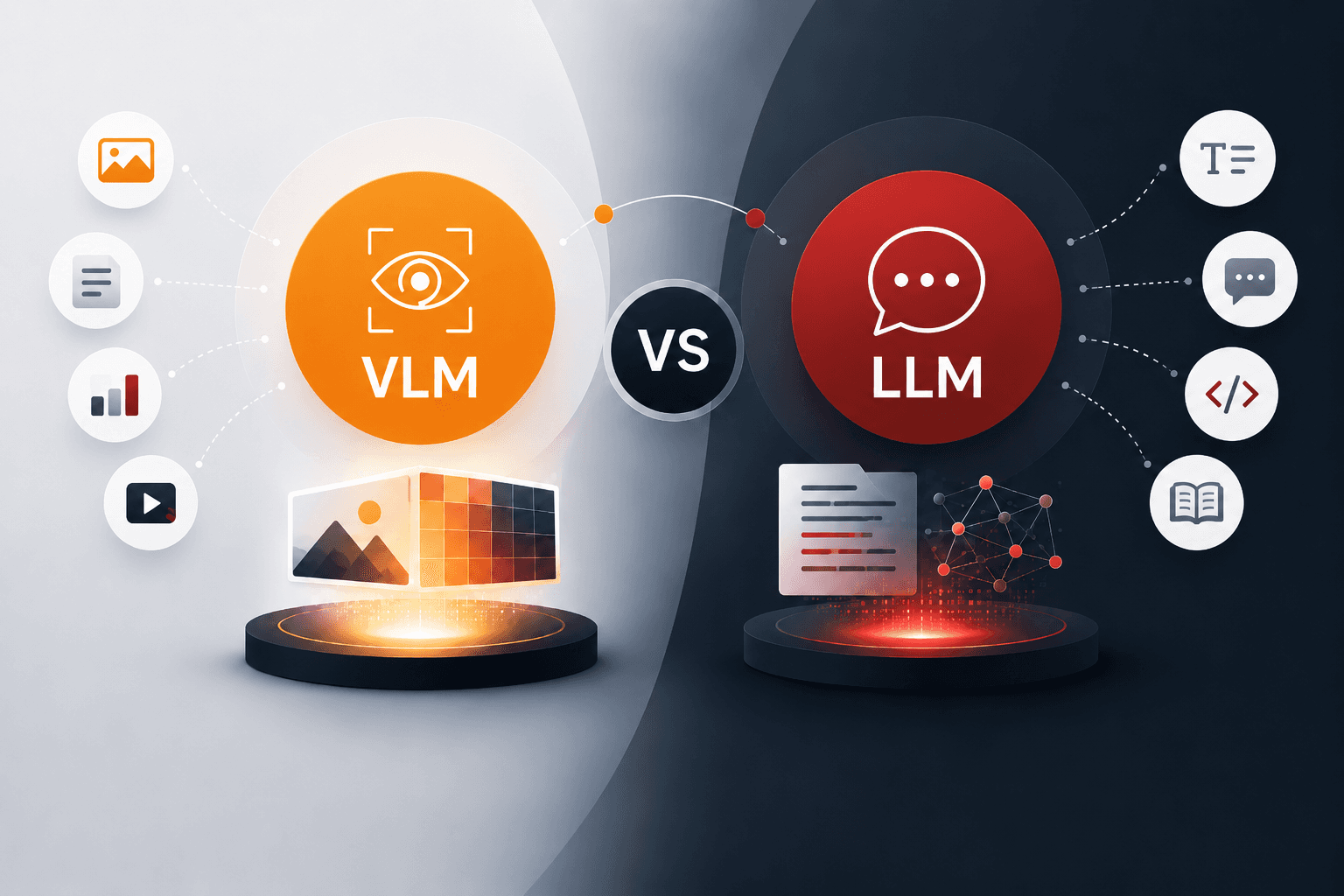
Two of the most frequently heard terms in the AI world over the past few years are LLM and VLM. But what do these two concepts actually mean? Why does the difference between them matter? And the most critical question: when should you use which one as you automate your business processes?
In this article, we explain both models in plain language, compare their strengths and weaknesses and make them concrete with real use cases.
What Is an LLM?
LLM is short for "Large Language Model"; in Turkish, it is translated as büyük dil modeli. Its core task is to understand text and generate text. These models are trained on huge data sets compiled from the internet, books, academic papers and many other written sources, and they can handle a wide range of tasks, from answering questions to writing code and from summarizing to translation.
ChatGPT, Claude, Gemini and Llama are the best-known examples in this category.
You can use an LLM for tasks such as:
- Automatically classifying and answering customer emails
- Turning long reports into short summaries
- Drafting code or explaining existing code
- Querying sales and CRM data in natural language
- Setting up multilingual communication flows
LLMs work only with text. If you give a standard LLM a photo, a chart or a screenshot, it cannot process it, because it has no eyes.
What Is a VLM?
VLM stands for "Vision Language Model", or visual language model. It is a multimodal type of AI that adds vision to the capabilities of an LLM. It can understand and process both text and images at the same time.
GPT-4o, Claude 3, Gemini 1.5 Pro and LLaVA are some of the models in this category.
VLMs can perform tasks such as:
- Generating descriptions and tags automatically from a product photo
- Extracting data from images of invoices, forms or receipts (far beyond OCR)
- Detecting and explaining an error in a screenshot
- Interpreting security camera footage
- Digitizing handwritten documents and making sense of them
In short, a VLM is a model that both reads and sees the world.
The Key Differences Between LLM and VLM
Feature | LLM | VLM |
|---|---|---|
Input type | Text only | Text + visual (image, video frame, document) |
Core capability | Language understanding and generation | Visual interpretation + language |
Typical use | Chatbots, summarization, code, translation | Document analysis, product recognition, visual question answering |
Compute cost | Relatively low | Higher |
Example models | GPT-4, Claude 3 Haiku, Llama 3 | GPT-4o, Claude 3 Sonnet, Gemini 1.5 |
The most critical distinction is this: an LLM lives in the world of text, while a VLM also understands the visual world. Both understand language, but a VLM can also interpret a photo, chart or table in context.
Which Model to Use in Which Situation?
Choosing the right model is a critical decision in AI automation projects, for both cost and efficiency.
Choose an LLM:
- When you categorize incoming requests and route them to the right team
- When you extract action items from meeting notes
- When you turn JSON data from an API into natural language
- In text-based reporting and notification flows
Choose a VLM:
- When you automatically process PDF invoices from suppliers
- When you run visual quality control on a production line
- When you generate content automatically from e-commerce product images
- When you digitize employee ID documents or forms
In many modern automation workflows, the two models work together: the VLM interprets the image and extracts text, and the LLM processes that text to trigger the next step.
The Role of LLMs and VLMs in AI Automation
At Synchron Bilişim, when we integrate automation tools such as n8n, Zapier and Apache Airflow with AI models, we see first-hand how fast and error-free workflows can run.
For example, in an email-based customer service automation, an LLM can classify incoming messages instantly and route them to the right department. When you add a VLM to the same flow, the invoice image or product photo that the customer attached to the email is also analyzed automatically and attached to the ticket. With no human intervention, in seconds.
Multi-layered automation structures like this can be applied in many areas, from support processes to accounting workflows and from logistics to human resources operations.
LLMs and VLMs represent two powerful branches of AI. One handles language expertly, and the other brings the visual world into the equation. Matching the right model with the right workflow multiplies the value you get from automation projects.
If you are not sure which model fits your business processes better, or if you plan to integrate AI into your existing automation infrastructure, the Synchron Bilişim expert team supports you at every stage, from needs analysis to deployment.
About the author
Synchron