Cyber Security
People, Not Technology, Get Hacked: Social Engineering Attacks
Social engineering attacks target people, not systems. Review the 4 methods that target SMBs most and the verification steps that prepare your team.
- Author
- İrem
- Category
- Cyber Security
- Published on
- Updated on
5 min read
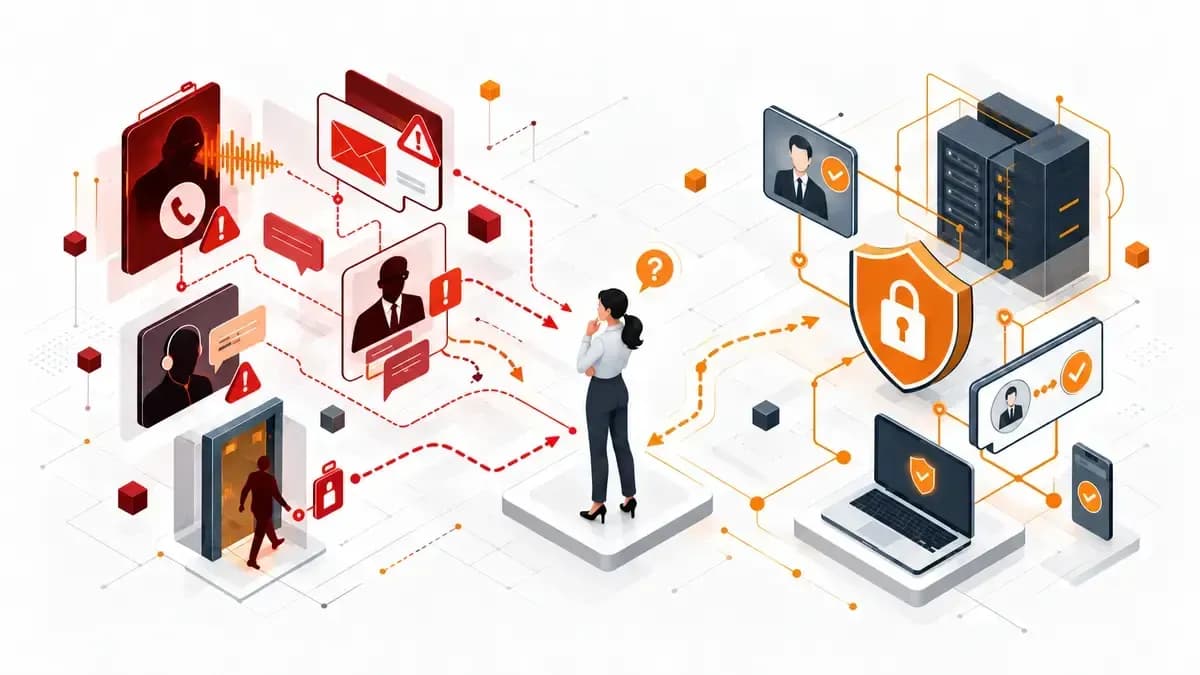
The phone rings. The caller says they are from the company’s IT department, that they have found an urgent security issue, and asks you to confirm a few details to fix it. The voice sounds trustworthy and the urgency feels real. But the person on the other end of the line is not who they seem.
Software vulnerabilities can be patched and firewalls can be strengthened, but the human factor remains the least predictable variable. Social engineering attacks target exactly this point: the basic weaknesses of human psychology, such as trust, urgency and authority.
In this article, we cover the four social engineering methods that target SMBs most and the concrete steps that prepare your team against them.
What Is Social Engineering?
Social engineering is an attack method that reaches its goal by persuading or deceiving a person who has access to a system, instead of breaking the system technically. These attacks can bypass even the most advanced technical defenses, because their target is the person, not the system.
Attackers usually do research in advance; they learn the company’s organizational structure, employee names and business processes to make their request as convincing as possible. This preparation also significantly lowers the chance that the attack is noticed.
Small and medium-sized businesses usually run fewer formal verification processes than large enterprises, which makes them an especially attractive target for social engineering attackers.
4 Common Social Engineering Methods That Target SMBs
Although these attacks come through different channels, they share the same logic: create a sense of urgency and authority to weaken the reflex to question. Each method has its own warning signs; recognizing them is the first step to stopping the attack early.
1. Vishing: Fraud by Phone
The attacker calls, pretending to be a bank, a supplier or someone inside the company, and asks for sensitive information or a transaction. By creating urgency ("your account is at risk right now", "you must approve this transaction immediately"), they aim to make the victim act without questioning. Caller ID spoofing increases trust further and makes the call appear to come from a familiar source.
2. BEC: Business Email Compromise
In Business Email Compromise (BEC) attacks, the attacker impersonates the email account of a manager or business partner — sometimes actually taking it over — and asks employees for an urgent money transfer or sensitive data. These attacks are usually carefully prepared and look very similar to real business correspondence; the signature, tone and even the previous email history can be copied.
3. Fake IT Support Calls
The attacker calls an employee pretending to be from the company’s IT department and asks for a username, password or remote access "to fix the problem". This method works especially well on employees who feel less confident about technical topics.
4. Tailgating: Physical Unauthorized Entry
Social engineering is not limited to the digital world. In tailgating, the attacker physically follows an authorized employee into an area protected by card access — usually by taking advantage of politeness or inattention. This access can reach server rooms or sensitive documents directly.
The Most Effective Shield: Awareness and Verification Protocols
What these attacks have in common is that they exploit a behavior pattern, not a technical flaw. That is why the most effective defense is also human-focused rather than technical: regular awareness training and clear verification protocols.
For example, simple but binding rules — such as confirming money transfer requests through a second channel, or IT support never asking for passwords by phone — can neutralize most of these attacks. Regular scenario-based training strengthens the team’s reflex to spot a suspicious request immediately.
First Steps to Prepare Your Organization
Alongside awareness training, it is critical that reporting a suspicious request is easy and non-punitive. Employees should not hesitate to report it right away, even if they clicked a link by mistake, instead of hiding it.
Regular simulated phishing and vishing tests let you measure in a safe environment how your team would act during a real attack. The results also show where your training program needs to be strengthened.
Planning extra and more frequent training for high-risk roles — finance, accounting, human resources and executive assistants — strengthens the targets attackers prefer most.
Technical layers should not be neglected either: email authentication protocols (SPF, DKIM, DMARC) and multi-factor authentication add a security layer that makes it harder for a social engineering attempt to turn into a successful takeover.
Conclusion: Security Investment Must Cover the Human Factor
Social engineering attacks show that security investment cannot be limited to technology alone. A team that can recognize these attack types can become one of your organization’s strongest lines of defense.
The awareness you build in your team today may be the most important factor that decides whether an attack you face tomorrow succeeds.
At Synchron Bilişim, we work with you to evaluate your organization’s needs for awareness training and security protocols. Contact us to assess together how prepared your team is against social engineering attacks.
About the author
İrem