Cyber Security
Why Zero Trust Architecture Is Now a Must for Companies
Corporate security was once based on one idea: if you got into the company network, you were trusted. Inside the firewall, there was no problem. That era is over.
- Author
- İrem
- Category
- Cyber Security
- Published on
- Updated on
5 min read
Corporate security was once based on this logic: if you managed to get into the company network, you were trusted. If you were inside the firewall, there was no problem. This approach made sense at a time when everyone worked in the office, systems sat in the company building and threats came only from outside.
That era is over.
Today, employees connect from cafés, from home and from other countries. Data sits in the cloud, not on the company server. Applications run on SaaS platforms. Being "inside the network" no longer means you are safe, because attackers have learned to get inside the network too. Credential theft, phishing, insider threats… none of these care about the firewall.
Zero Trust is the answer to exactly this reality.
What Is Zero Trust?
As the name suggests, Zero Trust is a security model based on the principle of "trust no one by default." No matter who the user is, where they are or which device they use, treat every access request with suspicion and verify it.
In the traditional model, the logic was: get onto the network and you can access everything. In the Zero Trust model, the logic works like this: every resource, every application and every piece of data is verified separately. Being verified once does not mean trust automatically carries over to the next access.
This is not a piece of software but an architectural approach. You do not move to Zero Trust by buying a single product. It comes from designing multiple security layers to work together correctly.
Why Is It No Longer Optional?
Credential attacks have exploded
According to Verizon's annual data breach reports, the vast majority of security breaches stem from stolen credentials. Attackers no longer break into systems; they log in. An attacker who joins the network with a valid username and password becomes almost invisible in the traditional security model.
Hybrid work is here to stay
The remote work model that accelerated with the pandemic has become a standard with no way back. Employees do not always connect to the company network over a VPN, not every device belongs to the company and not every connection comes from a secure network. Under these conditions, the "trust once inside the network" approach no longer works.
Cloud and SaaS have become widespread
Data and applications are no longer in one place. Microsoft 365, Salesforce, ERP systems, project management tools… each sits on a different platform. Traditional perimeter security cannot cover this distributed environment.
Regulatory pressure is increasing
KVKK (Turkey's Personal Data Protection Law), the GDPR and sector-specific security standards require companies to be able to audit and record data access. The access control and logging infrastructure that Zero Trust provides is becoming the most direct way to meet these compliance requirements.
The 5 Core Components of Zero Trust Architecture
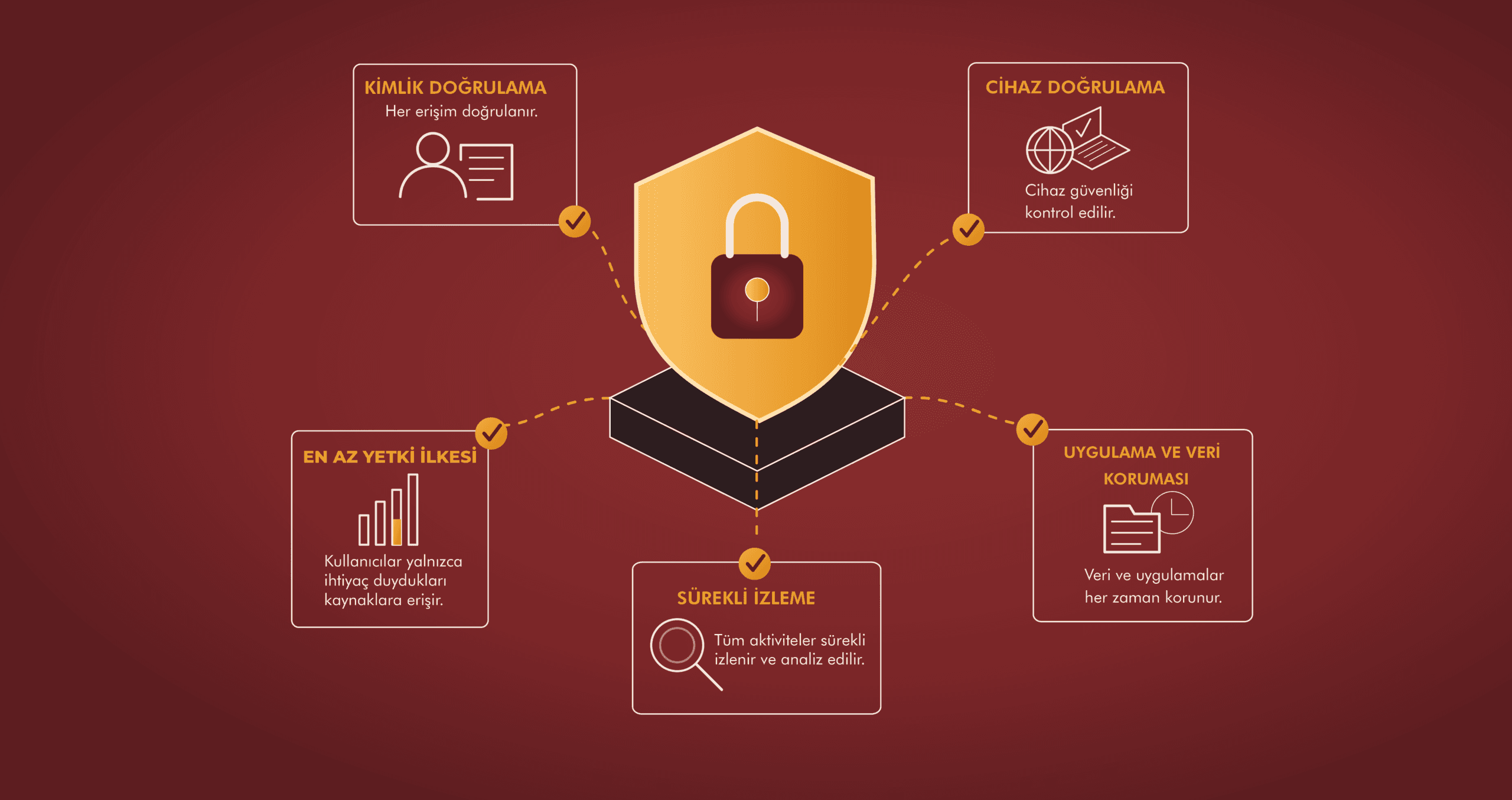
1. Put MFA at the center of authentication
The first and most critical step of Zero Trust is strong verification of every user's identity. Multi-factor authentication (MFA) ensures that a stolen password alone is not enough. Modern identity platforms such as Microsoft Entra ID can use risk-based MFA to automatically request additional verification for suspicious sign-ins.
2. Apply the principle of least privilege
Every user should be able to access only the resources they need to do their job. An accounting employee should not have default access to IT systems, and an IT employee should not have default access to financial data. Drawing this line reduces insider threat risk and stops damage from spreading if an account is compromised.
3. Define Conditional Access policies
Authentication alone is not enough. Besides "who is connecting?", you also need to answer "from which device, from where and at what time?" Conditional Access policies make access decisions based on these variables. A user connecting from the office on an up-to-date company device should not have the same access experience as a user connecting from an unknown device in another country.
4. Divide the network into micro-segments
In a traditional network, once attackers get inside, they can move laterally across the whole system. Micro-segmentation restricts this movement. Every system and every application sits within its own security boundary; compromising one segment does not give automatic access to the others. This isolation is vital, especially for environments that host critical systems and sensitive data sets.
5. Continuous monitoring and anomaly detection
Zero Trust is not a "verify once and pass" model but a "verify continuously" model. User behavior, access patterns and system logs must be monitored continuously, and activity that deviates from normal must be detected immediately. SIEM and SOC solutions form the backbone of this monitoring infrastructure.
Moving to Zero Trust Does Not Happen Overnight
Zero Trust is a goal and a gradual journey. Trying to change everything at once is both costly and risky. The right approach is to move step by step, prioritizing your existing security gaps.
The three most critical first steps are: strengthening your identity infrastructure and making MFA mandatory, restricting overly broad access permissions and starting to monitor access logs. Even these three steps significantly raise the security level of many companies.
Start Your Zero Trust Journey with Synchron Bilişim
Moving to a Zero Trust architecture requires identity management, network security, endpoint control and continuous monitoring to be designed correctly together. Knowing which step to start with and building a roadmap that fits your existing infrastructure is the most critical part of the process.
At Synchron Bilişim, we assess your organization's current security posture and help you implement Zero Trust components step by step. Explore our cybersecurity services.
About the author
İrem