Managed Services
The Infrastructure Forgotten in an Office Move: Getting Structured Cabling Right the First Time
Cabling left to the last minute in an office move causes years of problems. We cover 5 steps to get structured cabling right the first time and 4 common mistakes.
- Author
- Synchron
- Category
- Managed Services
- Published on
- Updated on
5 min read
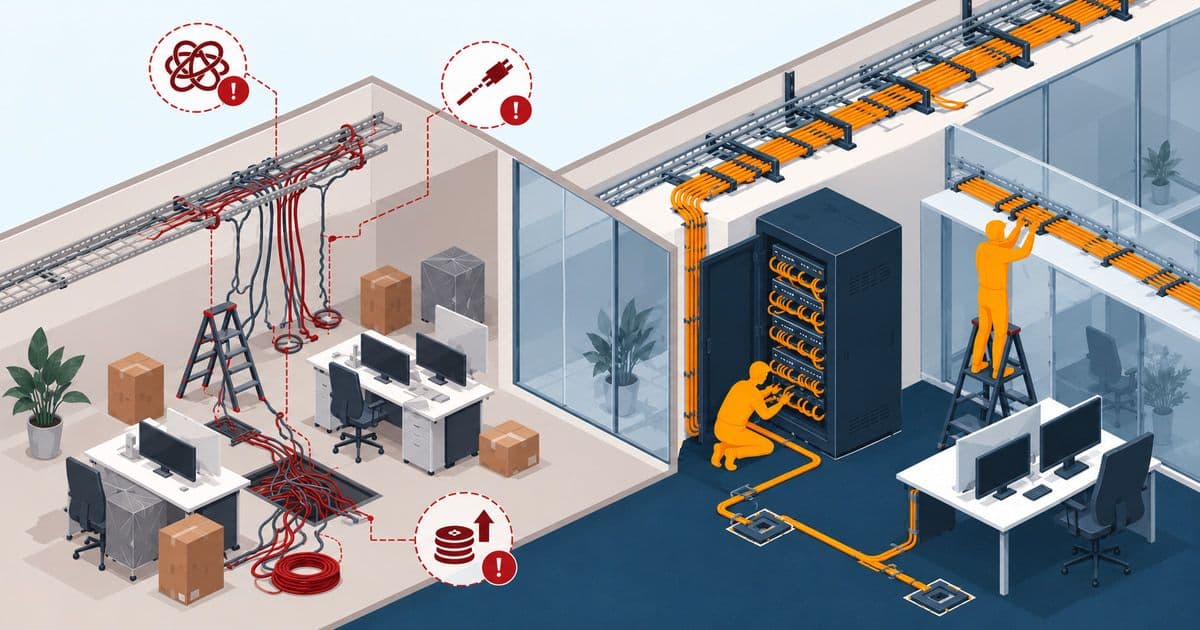
The furniture in the new office is in place, the lighting is finished and the glass walls of the meeting rooms are up. Then, in moving week, someone notices: half of the desks have no network outlet, the cabinet is squeezed into a storage corner and nobody knows which cable goes where. Structured cabling was left to the very end of the plan.
This happens often in office moves. Yet network infrastructure is one of the most basic systems an office will use for years. In this article, we cover the points to watch to get structured cabling right the first time.
Why Shouldn't Structured Cabling Be Left to the Last Minute?
Because cabling runs inside walls and ceilings, and every change made later costs more. Cabling runs inside walls, suspended ceilings and raised floors. Every change made after construction and fit-out are finished is both more expensive and more disruptive.
Poorly planned infrastructure comes back as too few outlets, connection problems caused by long cable runs, cabinets without ventilation and hours of cable tracing during faults. And these problems last for as long as you stay in the office.
Computers, switches and wireless access points are replaced every few years, but the cabling inside the walls usually stays in place for as long as you stay in the office. This is why cabling should be treated as a long-term infrastructure investment, not a short-term expense.
Proper planning today also removes the need to replace cables when you move to faster devices in the future.
5 Steps to Getting Structured Cabling Right the First Time
1. Site survey and needs analysis
The locations of desks, meeting rooms, printers, cameras, wireless access points and other devices are marked on the office plan. Growth over the coming years should be taken into account alongside today's needs.
At this stage, an on-site survey reveals details the plan on paper cannot show, such as suitable ceiling voids for cable routes, column and wall obstacles, and the best room for the cabinet.
2. Choosing the right cable category
The cable category directly determines how many years the infrastructure will last. For example, Cat6 cable supports 10 Gbps over short distances (up to about 55 meters), while Cat6A can carry the same speed up to 100 meters. The right choice for your needs and budget prevents the cost of replacing cables later.
Besides the cable, all components such as outlets, patch panels and patch cords must be in the same category. A single lower-category component in the chain brings the whole link's performance down to its level.
3. Standard labeling
Every outlet, every cable and every patch panel port should be labeled with a consistent system. In well-labeled infrastructure, a faulty connection is found much faster; without labels, the same job can take hours.
Defining the labeling system from the start to include floor, room and outlet number lets you continue with the same logic as the office grows.
4. Organized cabinet layout
The cabinet should be placed in a location with enough ventilation, power and access space. When patch panels, switches and cable managers are arranged neatly, maintenance becomes easier and the devices last longer.
Remember to leave space in the cabinet for devices you will add later and to plan room for an uninterruptible power supply (UPS). A disorganized cabinet turns even the simplest change into a risky operation.
5. Testing, reporting and documentation
When installation is complete, every link should be measured with a test device and the results reported. Outlet numbers marked on the floor plan and the test reports form the basis of every future change.
Test reports are also proof that the work was done correctly. If a connection problem appears after installation, they let you quickly tell whether the issue is in the cabling or in an active device.
4 Common Mistakes in Structured Cabling
1. Planning only for today
Cabling sized for today's headcount falls short at the first stage of growth. Leaving spare outlets and free patch panel ports removes the need to open walls later.
2. Forgetting the wireless network
However widespread wireless networks become, wireless access points are still fed by cable. If their ceiling positions are not part of the cabling plan, coverage stays weak or extra cables have to be pulled later.
3. Running too close to power lines
Running data cables along the same route as power cables without enough separation can cause interference and performance problems. These problems usually show up as intermittent, unexplained disconnections and are hard to diagnose.
4. Skipping documentation
A cabling map that is not prepared when installation finishes comes back as lost time at the first fault or the first change. And when the team that built the infrastructure changes, this knowledge can be lost completely.
How Do You Fit Cabling Into the Office Move Schedule?
Structured cabling planning should start at the architectural design stage. Cable routes and outlet positions should be decided before the suspended ceiling and wall works are finished.
Cable installation runs in parallel with construction works; cabinet installation, testing and commissioning of active devices are completed before the move. That way, employees start working on their first day in the new office without connection problems.
Having the architect, the construction team and IT at the same table makes a big difference in this process. The location of the cabinet room, the power infrastructure and the cable trays can only be planned correctly through this collaboration.
Conclusion
Structured cabling is the invisible infrastructure your office uses every day. Planned correctly the first time, it serves without problems for years; left to the last minute, it becomes an ongoing cost.
At Synchron, we run your structured cabling projects end to end, from site survey and design to installation, testing and documentation. Contact us to plan your office move or refurbishment project together.
About the author
Synchron